A Note on Current Understanding
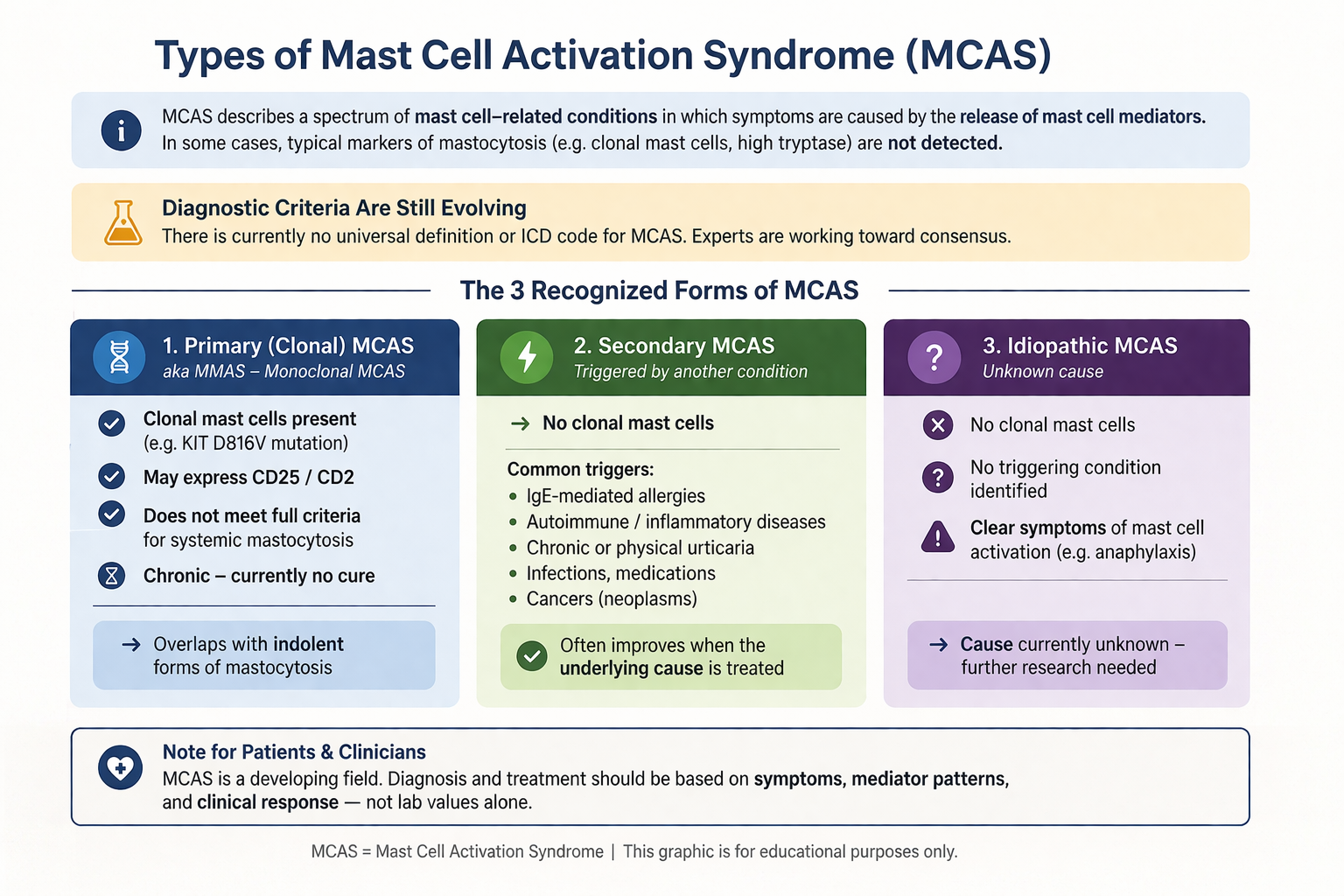
MCAS sits at the intersection of evolving science and clinical experience and remains an area of ongoing scientific debate. While definitions and diagnostic criteria are still being refined, the goal is to support individuals based on their symptoms, functional impact, and response to treatment — rather than relying solely on rigid laboratory thresholds.
There is currently no universally accepted definition, and in Germany, MCAS does not yet have its own ICD classification.
Because there is no full consensus yet, the following overview reflects current understanding while acknowledging ongoing uncertainty.
Mast Cell Activation Syndrome
Current Classification of MCAS
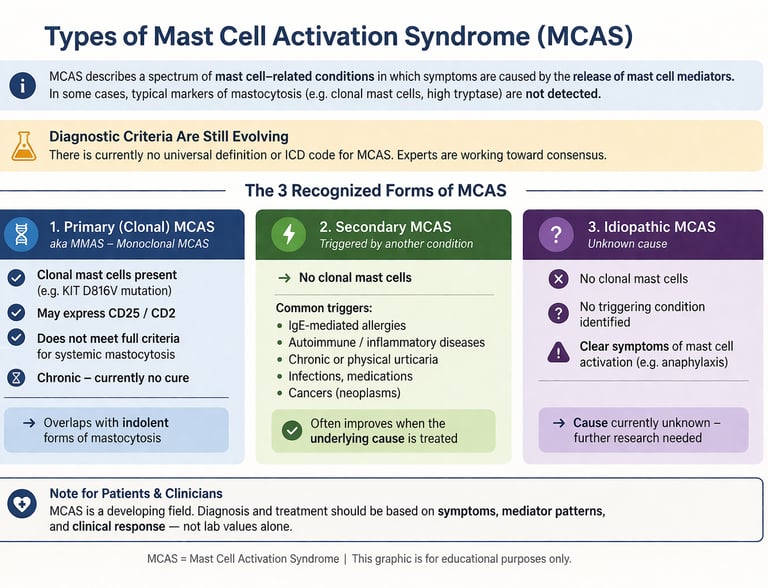
1. Primary (Clonal) MCAS
Also referred to as monoclonal mast cell activation syndrome (MMAS).
Clonal (genetically altered) mast cells are present
Often associated with mutations such as KIT D816V
May show expression of markers like CD25 or CD2
Does not fully meet criteria for systemic mastocytosis, but overlaps biologically
Currently considered a chronic condition without a definitive cure
2. Secondary MCAS
Mast cell activation occurs as a consequence of another underlying condition.
Common triggers include:
IgE-mediated allergies
Autoimmune or chronic inflammatory conditions
Chronic urticaria (including physical forms)
Infections or medication reactions
Neoplastic (cancer-related) processes
In these cases, treating the underlying condition often leads to significant improvement or stabilization of mast cell-related symptoms.
3. Idiopathic MCAS
No underlying trigger can be identified
No evidence of clonal mast cells
Symptoms clearly suggest mast cell activation (e.g. unexplained anaphylaxis)
The exact cause remains unknown.
It is possible that future research will uncover currently undetectable mutations or entirely different mechanisms that explain these presentations.
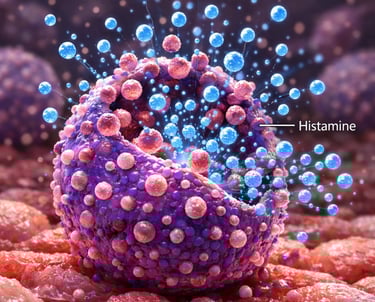
MCAS
More coming soon! Whatch this space. For now, here are some useful links below.
Where to get professional help
More info coming soon...
What you can do for yourself right now
More info coming soon...
Laboratory Testing
Information to lab diagnostic options in Germany
What I find hardest about having MCAS and how I manage it best
Over time I learnt to understand my triggers and through experimentation and adaptation, I learnt to know how to help myself best.

Infections
More info coming soon...
Medications
More info coming soon...
Dietary realted
Histamine rich food, ....
Mechanical factors
More info coming soon...
Toxins and chemicals
More info coming soon...
Stress
More info coming soon...
Confusion about the unpredictability, intensity and cause of my symptoms and feeling helpless how to help myself was hardest about having MCAS.
Follow me on threads to share your observations too so we can learn from each other.
Isolation, lack of support and social aspects
Use this space to introduce yourself or your business to site visitors. Share who you are, what you do, and the purpose of this website.


Short title
Short title
Feel free to include your background, experiences, and any unique aspects that set your business apart. Highlight your mission, values, and the benefits your customers can expect.
The link between hEDS and MCAS
More info coming soon...
Is MCAS the chicken or the egg?
What we know so far....
More info coming soon...
Diagnostic information
Information to lab diagnostic options in Germany
What to get tested
Understanding the labs
More info coming soon...
Different expert groups are discussing how best to define and diagnose this condition. Proposed approaches include:
A rise in tryptase of at least 20% above baseline plus 2 ng/mL
Measurement of other mediators such as prostaglandins
Clinical response to treatment (e.g. mast cell stabilizers, H1 and H2 antihistamines)
The presence of symptoms consistent with mast cell mediator release
Because there is no full consensus yet, the following overview reflects current understanding while acknowledging ongoing uncertainty.
Contact
info@joannabauersavage.com
© 2026 Joanna Bauer-Savage
All rights reserved
Joanna Bauer-Savage
10115 Berlin, Germany
Link to Wild Woman Reborn:
https://www.wildwomanreborn.com